
Flamstead Heritage Logo Grid Background Pattern

Wall Paintings in English Churches
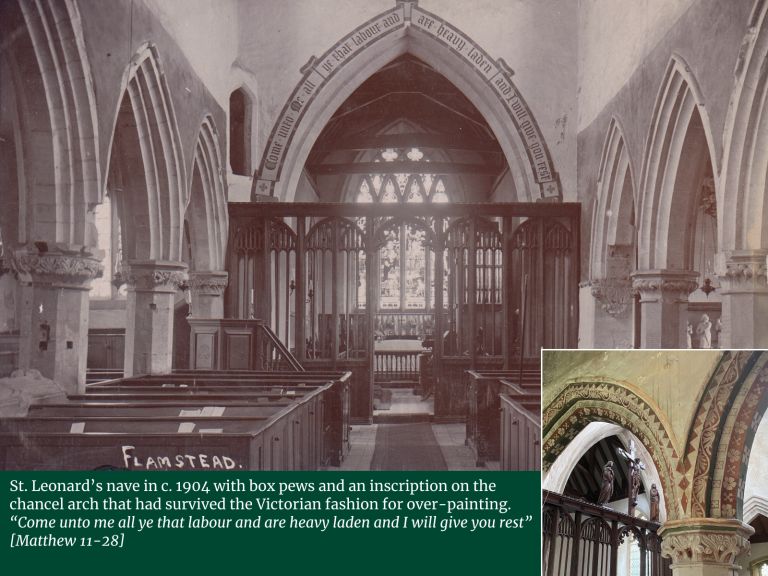
From its earliest history until the mid-16th century, the walls of St Leonard’s church were adorned with decorative and narrative wall paintings (murals) dating from the 13th century. They would have been very colourful and no doubt inspiring – or, in the case of the “Doom” (Last Judgement), terrifying.

The remaining paintings are just a small part of the original wall decorations. Only the red colour survives. The paintings depicted biblical scenes at a time when only a few could read or write, or even understand the language of church services: Latin.

The English tradition was to apply earth paint onto dry plaster (tempera), unlike for example in Italy where the paint was applied to wet plaster (fresco).

During the Reformation, painted decorations were considered idolatrous and often covered up or destroyed. Afterwards, biblical or theological texts were commonly used to decorate church walls instead.

The photograph, from the early 20th century, is of the nave before the wall paintings were uncovered. It shows a biblical text, now removed, painted on the chancel arch.

The inset shows 19th century painting on the soffit of north aisle arches. This gives an indication of the rich decoration once adorning the whole of the nave.

Wall Paintings in English Churches

The discovery of St Leonard’s wall paintings
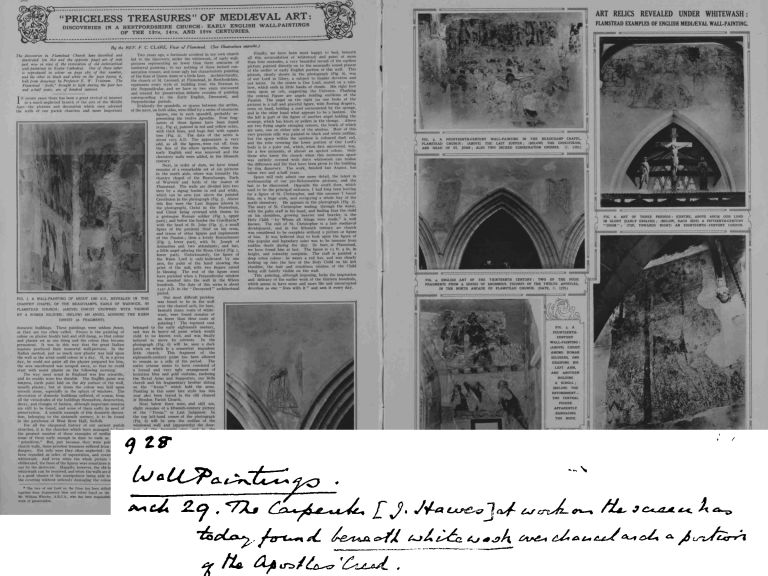
The wall paintings were first (re) discovered under many layers of limewash by the then vicar, Revd. Frank Conquest Clare in 1928 whilst building works were in progress.

With expert support initially from William Wheeler from Faith Craft Studies, Revd. Clare uncovered a number of the paintings. He wrote a pamphlet about the discoveries and a two page spread in the Illustrated London News – see below. He started the article thus:

“Two years ago, a fortunate accident in my own church led to the discovery, under the whitewash, of early wall-pictures, representing no fewer than three centuries of mediaeval painting; to say nothing of three incised consecration crosses, and some ugly but characteristic painting of the time of Queen Anne or a little later.”

The uncovering was a minor sensation at the time. It followed other newsworthy discoveries during building works in 1927, including a memorial stone to Dame Mary Luke, who had died in 1664, which was found under the chancel floor.

Further paintings were uncovered and conservation undertaken by E Clive Rouse and Ann Ballantyne in the 1970s.

The discovery of St Leonard’s wall paintings

St Leonard's Church Wall Paintings
St Leonard's Church Wall Paintings

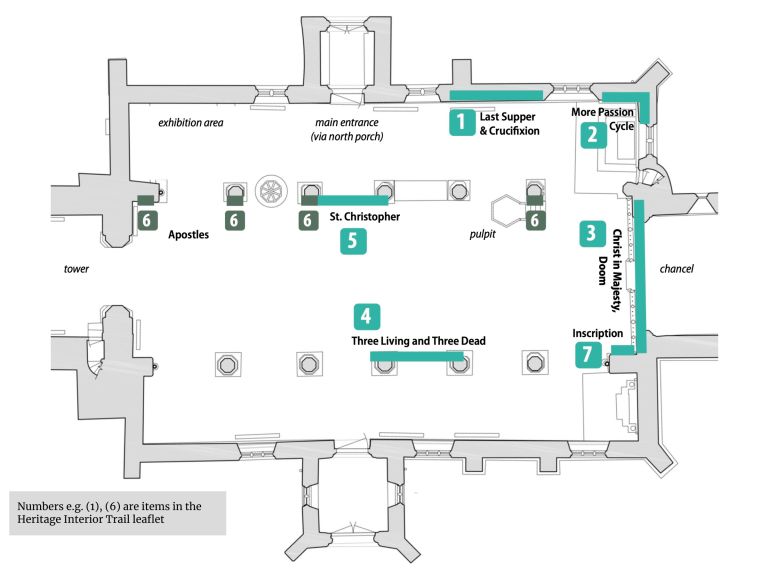
The Last Supper & Crucifixion: c.1350
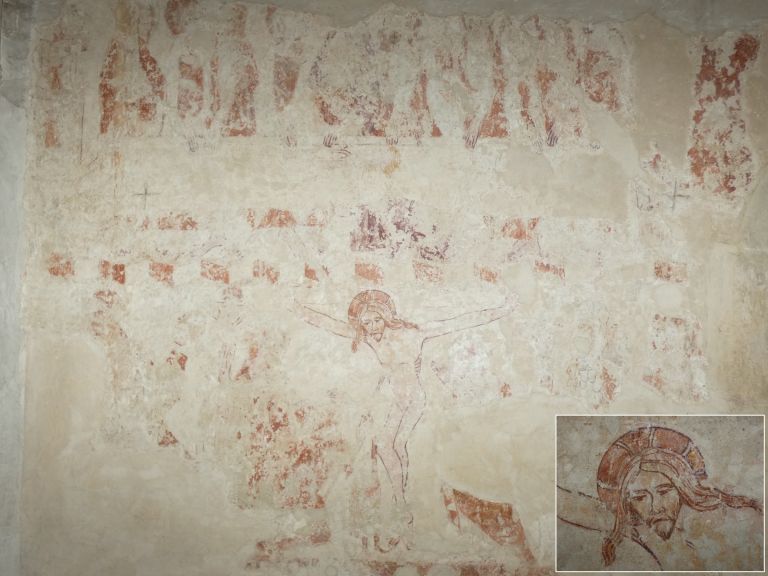
This is one of the most elaborate paintings in St Leonard’s Church, forming the first two scenes of a Passion Cycle. It is in two tiers. The upper tier features a traditional portrayal of the Last Supper, with Christ and the Apostles behind a table.

Below this, is a large scene of the Crucifixion. Christ is central, flanked by the weeping Virgin and St John. Longinus, who pierced Christ's side, is shown kneeling and a penitent thief is depicted on the left of Christ on the cross.

The Last Supper & Crucifixion: c.1350

Further scenes from the Passion Cycle: c.1350
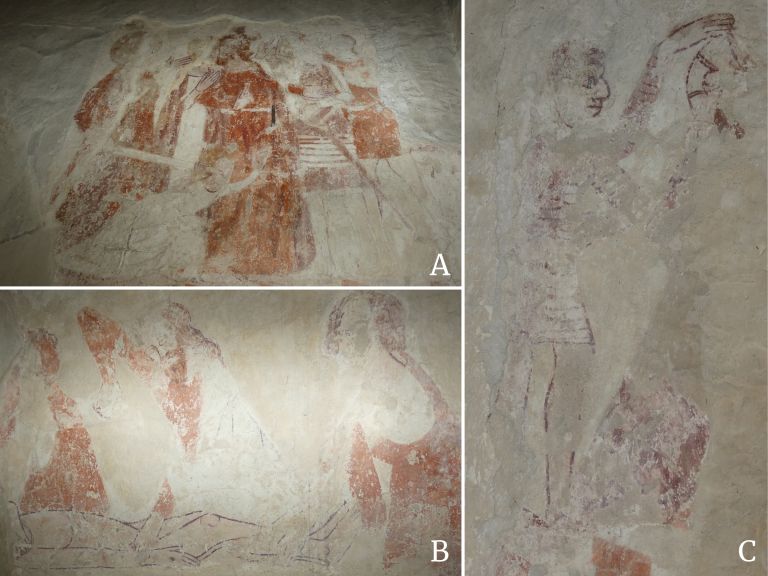
The other four scenes of the Passion Cycle are located to the right of the first two and are contemporary with them. Not shown is the Resurrection, now mostly lost.

  1. A  North wall - Upper part: likely to be The Betrayal in the Garden of Gethsemane. The scene depicts Jesus among soldiers during his arrest.

  2. B  North wall - Lower part: The Entombment of Christ: Three figures are shown laying Christ on a slab in the tomb.

  3. C  East wall: The Crowning of Jesus: Christ is being mocked by wearing a crown of thorns. Only His head and that of a tormentor in profile are clear.

Further scenes from the Passion Cycle: c.1350

Christ in Majesty/Doom: C14th, C15th, C18th
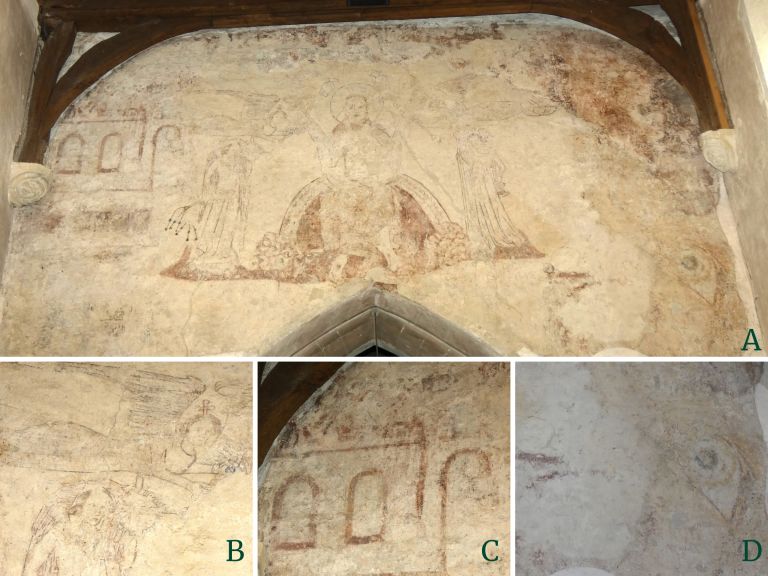
The wall above the chancel arch displays remnants of three painting schemes [A].

The (relatively) best preserved is late C14th and depicts Christ in Majesty, seated on a rainbow and clouds, with raised arms and wounds of the passion visible. Flanking Christ are two angels holding instruments of the passion. Above are two flying angels swinging censors [B].

The second scene, dating from the C15th is a Doom or Last Judgement. It includes a building on the upper left possibly representing the “many mansions that are in my Father’s house” or the Heavenly City itself [C]. In the lower right corner, there is a large depiction of the open Mouth of Hell [D].

There are also remnants of a post-reformation, C18th painting.

Christ in Majesty/Doom: C14th, C15th, C18th

The Three Living and the Three Dead: C15th
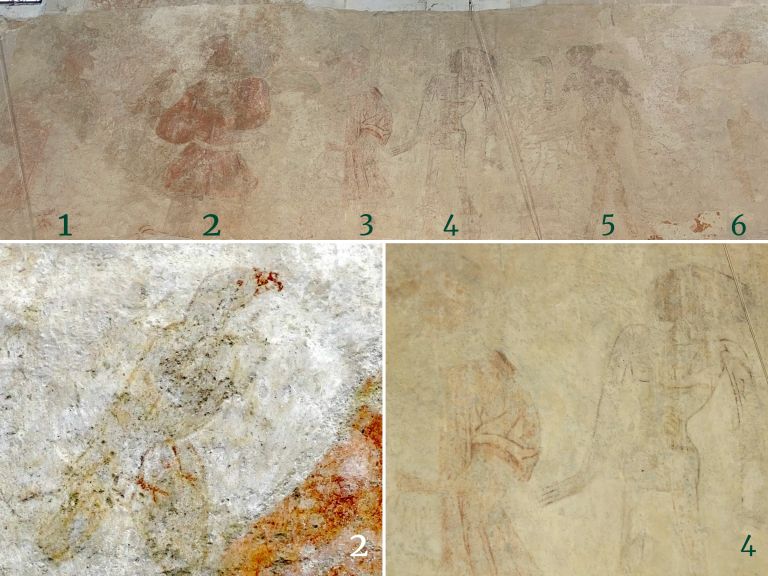
The composition portrays three living princes in elaborate robes on the left side [1-3], contrasted with decomposing figures on the right [4-6]. The three dead warn the three living saying: “As ye are, so were we, as we are, so shall ye be.”

The second living figure {2] holds a hunting bird, a key mediaeval status symbol, often taken into church.

The Three Living and the Three Dead: C15th

St. Christopher: 2nd half of C15th
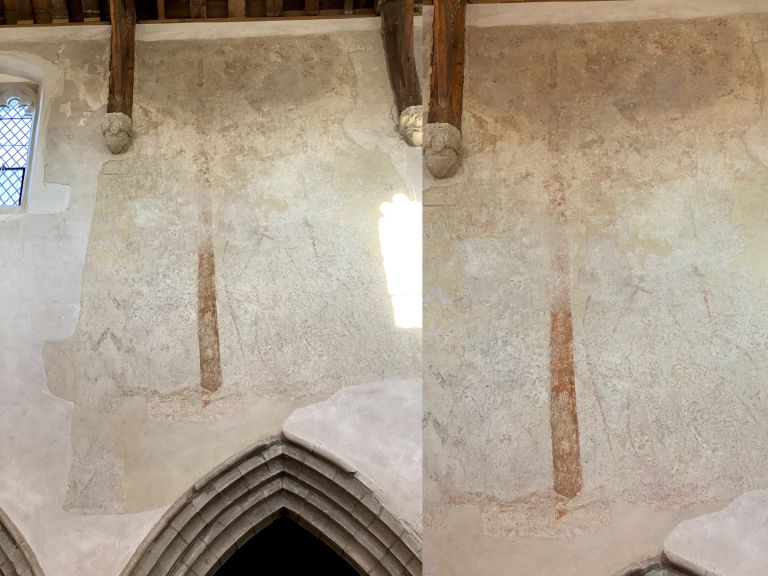
The most significant painting in the nave is a massive depiction of St. Christopher, a hugely popular saint in the middle-ages. The painting portrays him with a red hat and tunic, bare legs, and holding a large staff. He gazes at the Christ child seated on his left shoulder.

Positioned strategically on the north wall, this painting would have been the first sight for visitors entering through the then main entrance (from the south).

Representations of St Christopher were believed to provide protection from sudden death.

St. Christopher: 2nd half of C15th

The Apostles: C.1275
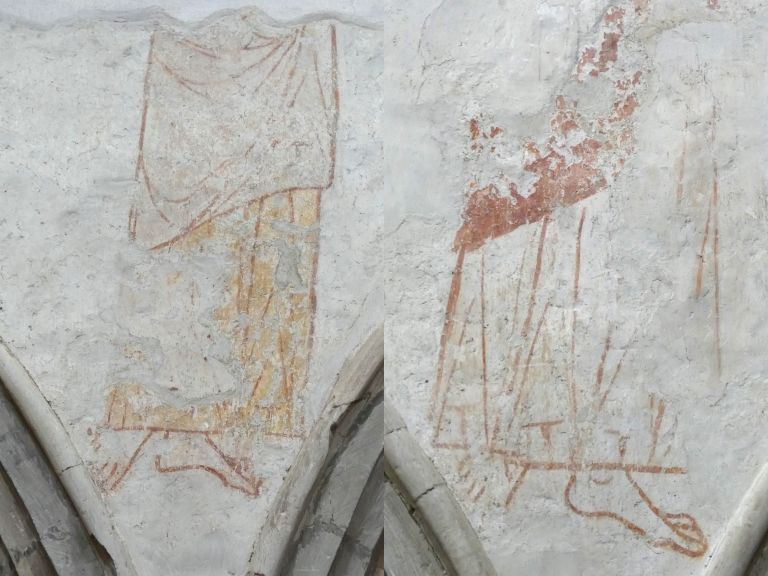
These are the earliest paintings of the church.

Only four fragments remain: just of the lower parts. The upper parts were lost when the nave walls were raised. Beforehand, there would have been all twelve.

The Apostles: C.1275

Firmyne Adames incsription: C16th
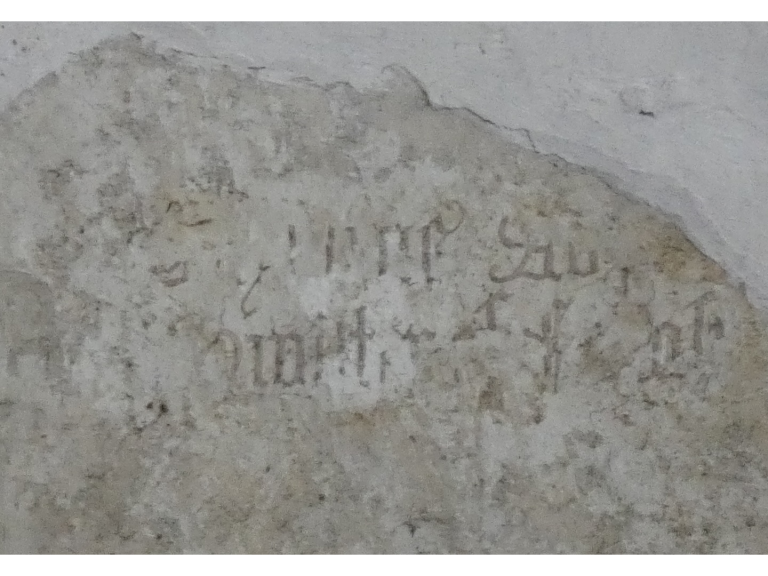
The fragment displays the outline of half an arch, representing an angel’s wing, possibly C13th. Above this, on another section of plaster, there is a line of Gothic-style script, bearing the name of the rector between 1578 and 1612:

“Firmyne Adames: Minister of Flamstead.”

Firmyne Adames incsription: C16th
Previous Slide Next Slide